-->
4 Ways to Teach Your Child to Sit Alone

4 Ways to Teach Your Child to Sit Alone


Has Your Child begun to show his desire to sit alone? Wow, congratulations, ma'am. When entering the age of 7 months, generally your child has been able to master the sitting position perfectly. Even so, if your child at home hasn't been able to do it perfectly, you don't need to worry. There are some tips that I got from the Mother and Toddler forum to stimulate the baby to sit alone. What are they? see more!

1. Raise the Stroller Backrest

The first way I did was to raise the stroller or the pushchair. For example, every afternoon walk with your child, I put Little on the stroller and make sure he was in a lean or half-seated position. That way he will be trained to hold his own body.

2. Prepare Toys nearby

One of the stimuli that you can do to encourage your child to sit alone is to bring the toy closer to where it is easy to reach. If your little one can just roll or crawl, you can attach the toy to the bedside wall [cs4]. When your child is interested in the toy, he will roll or crawl close to the wall and try to grab the toy. Make sure you keep watching her so that your little one doesn't hit the wall.

Well, if your child can sit back with help, you can put the toy in front of his feet. Slowly, your child will try to advance his body and hold his body with his hand to grab the toy. This method can encourage your child to try to hold a sitting position without leaning on your body or a high pillow.

3. Increase the time of prone

Maybe you often wonder, when can a babysit alone? Generally, the process of sitting baby begins with the prone process. Therefore, to simplify the process of learning to sit, get used to the little one prone first. Lying down can be an effective way to train balance, body coordination, and strengthen the neck and back muscles. When prone, your child will slowly hold the weight of his chest with his hands, then lift the buttocks and legs. He might learn to face down and shift his butt first before finally being able to sit alone. Well, this process will certainly occur gradually and takes time. So, you have to be patient.

4. Inviting Your Child to Reflect When Learning to Sit

Do you know? Babies are usually very happy to see their own faces in a mirror. Well, this can be used as a way to attract the attention of your child so you can learn to sit alone. You can start by holding your baby's arm to support his body. Be sure to not immediately remove it, ma'am. Let your child get used to the sitting position first, then if he is getting stronger holding his own body, then Mom slowly releases it.

Here are some simple tips that can be done to stimulate your child to sit alone. Regardless of the above method, the most important point is not forcing it. Generally, babies will begin to learn to sit when they reach the age of 4-8 months. So, you don't need to worry if another baby has started sitting while your baby hasn't, as long as his age is still in the age range above. Hopefully, the information for baby's stimulation so that learning to sit alone helps

Read more »
 Know the Causes and Ways to Overcome Red Eyes in Babies

Know the Causes and Ways to Overcome Red Eyes in Babies

 Know the Causes and Ways to Overcome Red Eyes in Babies

During this time maybe you thought that the condition of red eyes can only occur in toddlers and adults, yes. At first, I also thought so. However, in one of the online baby health consultation forums that I attended, a mother told me that a few days ago, her baby, who was only a week old, experienced this.

Then, the mother immediately took the child to the pediatrician to check the condition of her eyes. Here are some things the doctor explained to the mother regarding the condition of the red eye that the baby is experiencing:

A Glance Around the Red Eyes in Babies

Red-eye conditions or what is known in medical terms as conjunctivitis can occur to anyone, including newborns. Conjunctivitis occurs when the clear membrane lining the white part of the eye and the inner surface of the eyelids is inflamed. In newborns, inflammation is susceptible to spread to damage the baby's eyes if not treated immediately.

Red Eye Trigger or Conjunctivitis Factors

Inflammation of the cause of conjunctivitis in the eye can be triggered by various things, Mom. Among them are viruses, bacteria, and allergies. The following is the full explanation and how to handle it:

1. Conjunctivitis Caused by Viruses

Some symptoms that will be seen if your child has conjunctivitis due to viruses include:

The eyes of the Little one are red or pink, appear swollen in all parts, release fluids, and become more sensitive when exposed to light.
Along with the blushing of the eyes, your child also has a runny nose and discomfort so he cries constantly.

If this happens, what you can do to overcome it is:


  • Try to clean your eyes with caution regularly. Mother can do this by rubbing her eyes using a soft towel that has been moistened with warm water.
  • In addition, to reduce the sensation of pain in the eyes of your child, you are also advised to compress his eyes 2-3 times a day using a towel that has been soaked in warm water. Anyway, to make sure there is no water coming into the eyes of your favorite baby, make sure the towel has been squeezed properly before being used to compress it.


2. Conjunctivitis Caused by Bacteria

Meanwhile, for conjunctivitis caused by bacteria, the symptoms that will appear include:


  • Eyes are red or pink; feels pain in the end or part of the eye which is marked by the fusing of your child; Your child looks often trying to direct his hand to his eyes because it feels so itchy; the eyes release green or greenish yellow fluid and appear to be covered with skin in the morning when the baby wakes up.

If your child has conjunctivitis like this, you need to consult a doctor immediately to get an ointment or tablet that can help speed up the recovery of the baby's eyes.

3. Conjunctivitis Caused by Allergies

In addition to the two factors above, conjunctivitis can also be caused by allergies, ma'am. The trigger is usually smoke, dirty air, dust, milk, or interaction with animals. Some symptoms of allergic conjunctivitis include:

  • The eyes of the Little One appear swollen, red, runny, and runny stools.

To help reduce the discomfort felt by your child, doctors recommend that you compress your baby's eyes using a cold towel. In addition, you also need to find out what triggers allergic reactions to your child. That way, in the future, you can avoid the risk of allergies to your baby's favorite baby's eyes. However, get to the doctor immediately if your eyes don't get better.

Well, that is all conjunctivitis in babies that I know from a mother's cheating on an online forum. Hopefully, this info is useful.
Read more »
Recognize the Difference Between the Symptoms of a Baby's Pain and Teething

Recognize the Difference Between the Symptoms of a Baby's Pain and Teething

Recognize the Difference Between the Symptoms of a Baby's Pain and Teething

Along with looking after and caring for your child, I learned many things about the process of growth and development. One of them is when he passes through the phase of teething. according to the American Academy of Pediatrics, babies are generally teething when they are 4-7 months old. My child began to grow teeth when he entered the age of 6 months. When passing this phase, I often have difficulty distinguishing whether your child is fussy because of illness or teething. That's why I tried to find out how to distinguish it by reading various articles on child development. Here's the information I got.

Symptoms of the Little Fussy because of Teething

When your child is growing teeth, generally he becomes fussier because he feels itching and pain in his gums. Look, if your child experiences the symptoms below, maybe he is passing through the phase of teething.

  • Excessive saliva, because your baby's saliva production will increase when teething.
  • Rash around the mouth area, because it is often exposed to saliva.
  • The gums are swollen because the teeth will appear above the gum surface.
  • Like to bite objects around it, because swelling of the gums often makes your child feel uncomfortable.
  • High fever or above 38.5 ° C can be a sign that your child has a virus.
  • Rash on the body, maybe your child has measles, roseola, or other illness.
  • Having symptoms of pain, such as vomiting, diarrhea, coughing, and others.

To reduce discomfort during teething, I used to give the little one a toy that could be bitten or teether. Teether is generally easy to hold and safely put in the mouth of your child. Before playing, teether can be cleaned and cooled first into the refrigerator for several hours. This toy can help relieve itching and discomfort in the gums.

Symptoms of the Little Fussy because of Pain

Does your child keep crying and it's hard to calm? Maybe the child's health is being disrupted, Mom. Come on, recognize the symptoms below:

  • High fever or above 38.5 ° C can be a sign that your child has a virus.
  • Rash on the body, maybe your child has measles, roseola, or other illness.
  • Having symptoms of pain, such as vomiting, diarrhea, coughing, and others.

If your child experiences the symptoms above, chances are he is sick and needs to be examined by a doctor, Mom.

Well, that's some information that I got from various sources. Through this experience, in my opinion, distinguishing the symptoms of baby teething and pain because of other things is easy. However, if your child has a fever or cries without stopping, don't hesitate to consult a doctor right away. Hope your little one is healthy always!
Read more »
Obesity Problems In Children

Obesity Problems In Children

Obesity Problems In Children

Obesity Problems In Children
If your child has OBESITY or overweight Do not feel alone, According to a recent study an increase in the percentage of obesity in children in the world. What causes them and how to try to prevent or overcome them?

For small children this would not be a problem, but when the more mature words like fat, like balls, rhino, king kong, etc., will affect the confidence of a child. If your child has OBESITY or overweight. Do not feel alone. According to a recent study an increase in the percentage of obesity in children in the world.


Research shows that obesity in children today due to lack of activity in your lifestyle and also the way and eating habits. Obesity is a major risk factor for heart problems, high blood pressure, blood sugar etc.. Therefore parents should think about the future health of children.

There is no quick and easy way to help your child lose weight. Takes a long time to change the way of living and eating habits which may not correspond with the habits of your family.

Some tips to prevent or treat obesity in children:

  • Turn ON OUR OWN STYLE. As parents, we have to be a good example in the application of ways of living and eating healthy.
  • PROVIDE TIME FOR EXERCISE (activity). Discover desirable and exciting activities for you and your child can burn calories a case of running, swimming, cycling, running (jogging). Do this on a regular basis.
  • CHOOSE HEALTHY FOOD. Reduce food "fast food or junk food" that contains only high in fat and salt. Reduce the consumption of sugar. Give your child 3 meals with smaller portions and three small meals (snacks) in small portions, so that children do not feel hungry. Give water to drink too much juice such as orange juice containing fiber also vit.C, also gave a lot of eating fruits and vegetables. Choose low-fat snack.
  • Change your FAMILY EATING HABITS. Give the child to eat only when your child is hungry and not just want to eat something. If your child just wants to eat and eat again try to divert their activities or provide something else, because you know your child is really hungry. Never eat or snack for watching TV.
  • GIVE YOUR SUPPORT. It's important for the whole family to help change the way your child's life. Do not keep junk food, soda drinks that are rich in sugar, high-fat foods (potato chips, etc.) to your home. Prepare a diet low in fat and healthy for the whole family. Follow the exercise activity.
  • Give PRAISE OR CAUTION WHEN CHILD HAD TO DO SOMETHING GOOD. Reward and praise can motivate children to stay on a diet. For example, if your child within 1 week of an initiative to drink water instead of soda then praise your child, give gifts of toys or fun activity, but DO NOT give food as gifts.
  • Consult a physician. Periksakanlah your child to the doctor/pediatrician for weight control diet also check body every 2-4 weeks. Avoid weighing the child at any time at home because it may cause stress to your child.
As parents we must do our part to help our children, but only the simple act of providing a permanent change of lifestyle, exercise and eating habits in the child's future. All of which are very beneficial for the health of your child's future.
Read more »
Baby Massage Tips

Baby Massage Tips

Baby Massage Tips

Infant massage is not only beneficial to your child physically, but also can be a means by which you and your baby be alone in a relaxed and enjoyable atmosphere. In fact, for new mothers affected by postpartum depression, one of the medicine is activity on this one, baby massage!

Infant massage is increasingly popular in recent years, so if you want to learn firsthand, how many clinics, hospitals, and midwives who hold a baby massage training classes, especially in big cities.

Well, for those who want a peek, like what the heck that baby massage, here we lay out the steps, accompanied by pictures.

Infant massage techniques that we describe here is suitable for babies who can not crawl. Anyway, one important thing before you start, do not massage your baby just before or after drinking milk/eating, or when he was sleepy. The location could be anywhere convenient for both of you. What is clear, should be done on the floor and with a towel. Prepare a small bowl of oil (olive oil and virgin coconut oil is best).

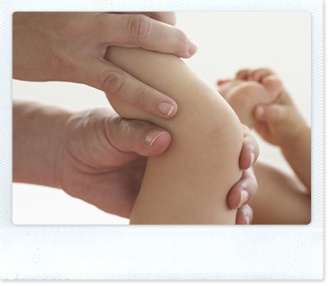
 Feet - this is the best part to start the message because it is the least sensitive among other body parts of babies. Dab a little oil, began to massage your hands slowly, starting from the thigh, hold it down. Make a message to alternate between your left and right hands. Massage movements must be as gentle as possible, mimicking the movement of milking. Move to the next foot massage again and do the same.
 Feet - Take one of her feet and gently rotate it several times to the left, then repeat to the right. After that, massage the soles of her feet back from the ankle to the toes. Move to the soles of the feet and repeat them as such.
Heel - Use your thumb to massage with a circle on your baby's heel

Pedicure - This is the cover of massage the baby's feet. Hold the tiny fingers one by one using your thumb and index finger, then gently pull the fingers so that the direction of your fingers off the baby's toes. Do it for the ten toes.

Arm - Take one arm and do the way you did with his legs - movements such as milking, starting from his armpit, and hold up to the wrist. Then hold the palm of his hand, and slowly circled a few times, to the right and left. Moving to the other arm and do the same.

 The soles of Hands - Using your thumb, massage the palm of your baby in a circular motion.


 Hand finger - same as toes, gently take his hand one by one finger using your thumb and forefinger and pull gently.

Chest - Grit your palms (like Buddha footprint), then put on his chest in such circumstances. Slowly, for outward movement of the baby's body, so that your palms are pressed slowly open side down, and end up sticking your hand and walk on his chest. Repeat several times.
Still on the chest, this time place the palm of your hand one with the face down, in the chest area, then make a gentle massage down towards her thighs. Make this movement alternately, with the right hand side of you.

Back - Turn your baby's body slowly, so he on his stomach. Position you are on one side. By using your fingers, make a gentle circular massage with both hands, starting from the bottom of his neck, down to the bottom of the child. Change your position to the other side again and do the same.


Still, on the back, this time make the massage a bit stronger than ever, starting from the shoulder, continued down to his feet.

Once completed, you can pair the diaper, and then hold or feed her. Good luck!


Read more »
How to clean the child's ear

How to clean the child's ear


How to clean the child's ear

Unlike adults, children can not clean its own ears. Therefore, the parents, especially the mother who must be diligent in cleaning the ears of their children.
But if you're not careful when cleaning the child's ear, will cause pain and even may result in the child's ear infection pda. So you must be careful.
The following are instructions for cleaning the child's right ear. First of all, apply baby oil evenly on your child's ear, until at the back of the ear, this was done so that dirt will not stick and easy to clean.

Read more »
Proper care for your child

Proper care for your child


Your child should be cared for properly. Treatment was carried out since they were babies. A good treatment will create a brilliant baby. Therefore, we must be smart in choosing baby care products.
If intelligence is the ability to learn, so newborns can be called a genius. Because the baby's brain has the potential to learn anything and the parents who play an important role in determining how much and how their babies learn. Every parent must want to have a smart baby and infant brilliant.

Read more »
Characteristics of Baby Worms

Characteristics of Baby Worms


Worms is a disease that often affects infants and toddlers. Worms occur because the baby's body infected by parasitic worms, parasitic worms that include pinworms, tapeworms, roundworms, and hookworms. Worms in the baby into the baby's body through the pores of the food or the baby's body. Unhygienic environment and lack of attention to hygiene to be the biggest factor outbreak of intestinal worms in infants.
Read more »
Epilepsy In Infants

Epilepsy In Infants


Syndrome brain nerve abnormalities in the form of epilepsy or epileptic seizure characterized by sudden and repetitive. This disorder occurs in infants due to a disturbance in the nerves of the brain that regulate the system vision, hearing, muscle movement, though, and so on. In the normal brain, all the performance and activity of the brain nerves run in harmony in accordance with their respective functions.

But for some reason, the condition was not normal in infants with epilepsy and there is chaos in the brain sensors, so there is a seizure. On the other hand, causes of brain disorders were different each individual but in infants can be caused by congenital defects in brain structure since they were in the womb, or may suffer a head injury or infection that causes epilepsy.
Read more »
Prevent Child Bedwetting

Prevent Child Bedwetting

Bedwetting is common in young children. But if this is sustainable, will be very inconvenient because it is most closely related to cleanliness. As a human baby pee more than 20 times a day because it has not been able to control bladder .. But if it stepped on school age, of course, the ability to control bladder was already existing and well developed.
Many factors could cause why the child's bedwetting. If this happens from birth, the possibility of infection of the urethra caused by damage to the bladder wall so that the drugs do not work well. Other causes are genetic or hereditary factors. If the parents have a urinary tract infection, it could be his son, too. In addition to these two factors, there are several reasons why children often wet.
Among other things, social or psychological barriers during the developmental period between ages 2-4 years, and also the lack of parental concern will be how to educate children and teach children how to use the toilet since childhood.
Then how to overcome bedwetting in children? In this case you should teach children good habits early on. At age 5 months, children get used to pee in the shower and ask him to communicate during a pee. Do not be too dependent on the use of diapers, as this can make children lazy and do not control the bladder. Pampers is practical, but only at the time of the trip so as not to bother. If you already can speak, teach and remind the kids to pee before bed.
Sometimes though the child had to pee before bed can also be wet. To overcome the 2-3 hours after the child was asleep, was awakened try to pee again. Usually the child lazy to get up and if so the parent should be patient to lift it and be reminded to pee.
But if the child is still wetting the bed, give him praise for his efforts, if successful does not wet the bed. Reduce drinking water at night, and if necessary provide potty near the bed. Do it and get used to the things above, because it will educate the child to develop good habits and discipline.
Read more »
Myth Bedtime For Children

Myth Bedtime For Children

Many ways that can foster a sense of togetherness within the family, especially in relation to a child with his parents and also, one that people think that these activities are very expensive and time-consuming, because of course there are some activities that can foster a sense of community amid the family but not necessarily sacrificing a lot of time and money, among the many activities that include storytelling or reading stories to our baby son before bed.

Although even seem trivial moments of togetherness is the most awaited and memorable children from their parents and also to educate the children are very precise storytelling and of course fun to do together.

If overseas read the fairy tale is one of the obligations of parents who want to have kids who are good and rich in imagination, because according to research by telling tales to children before bedtime can create the image of the character, environment, nor about other people within the children. Children who like to listen to fairy tales usually rich in imagination.

They will also have a vision and a better perspective in judging other people or situations that occur around him in other words this way is another form of how to love a child.

Parents also can take advantage of the media stories of giving advice or orders to his son. However, a tale not absolutely have to have the content of his advice, is just too entertaining not a problem, because children basically has its own reasoning power. In other words, fairy tales do not have to always carry a moral message about the goodness or badness.

It would be better if the father and mother accompanied her child together, so the child can feel the warmth of affection of his parents, other than that both parents also joined together to care for children.
Read more »
Fever Infant

Fever Infant


Fever is a condition where the brain reprogrammed body temperature above normal temperatures are above 38C. However, the real heat when the temperature is less than 38.5C. Due to the increasing demands of these temperatures the body will produce heat which would cause the baby has a fever.

In addition to damage the health of infants, in some cases there are up to cause death, tragic indeed but of course this can be prevented if we know the proper way

Fever is not a disease, fever is a symptom (fever) that something is going on in our bodies. Cough, vomiting, diarrhea, also not a disease but a symptom. Faced with these symptoms, the most important thing to do is find out what causes it.

Indeed, all children, not to mention a baby, have the ability to raise the temperature of the body as a reaction against diseases caused by germs or viruses that attack the body, that's why babies get a fever, so we as parents should give vaccinations and immunizations as soon as possible which would help protect infants from germs and virus attacks.

Also if the baby had already had a fever, here are some simple ways you can practice yourself at home if your baby suddenly of fever, such as drinking a lot, because fever can cause dehydration further compress the child with warm water not cold water because if given cold water, the baby's brain will think that the cold temperatures outside the body so the brain will tell your body to raise its temperature by shivering to produce heat.

As a result, instead of the child's body temperature down, but the added heat, if its body temperature did not show any changes in the given good febrifuge, of course, that contain acetaminophen or paracetamol.
Read more »
Colic In Babies

Colic In Babies

Have you ever heard the term colic? Or maybe colic disease? Certainly for those of you who have babies often have constraints on your baby, such as your baby cries excessively aka unnatural and very difficult to calm him down. This is called colic.
Colic is actually not a disease, but rather leads to a condition where the baby is very fussy and crying continuously without interruption for more than three hours a day and usually lasts at least three days a week.
Colic usually occurs in the first three months of birth, and will stop by itself as infants at the age of four months. Colic is more common in infants who received nutrition by giving the bottle compared to breastfed infants. The frequency of infant crying during colic attack took place at certain moments, usually in the afternoon and early evening. Symptoms of this are the baby's colic will cry like a screaming loud and hard even when the condition is allowed to stand looks perfectly normal. His legs will be lifted up and the possibility of a baby in a state of bloated stomach.
Read more »
Baby sign language, the new Trend

Baby sign language, the new Trend

Here are some tips that may be the mother:

    1. When mothers work, replacement of the mother who, because of the role of surrogate mother figure also determine keoptimalan of child development. For the mother needs to work with caregivers in order to continue to monitor the growth and development of children. Mothers should actively seek out any information about the growth and development of children.

    2. Mothers should take the time to meet up for lost time with the children. Thus, emotional closeness is still awake and the mother can continue to provide stimulus to the growth and development of children so that children can develop optimally.

    3. Children who grow up with healthy then the ability will also be well developed, in other words children who are physically fit then the intelligence will also be developed in accordance with its potential.
Read more »
10 Ways of Developing Brain fo babies

10 Ways of Developing Brain fo babies


Described by Dr. Eddy Supriyadi, SP.A, from RS Sardjito Yogyakarta, there are two basic components in a child's brain development, which is environmentally safe and positive experience.
When a baby is feeling depressed, the brain will respond by producing cortisol substances. High cortisol levels will slow the development of the brain.

Safe and comfortable environment necessary to help the infant brain development. Give a response when the baby crying and babbling.

Experience received each day will also help the brain development of children. Activities performed in daily life, such as taking children to the market or to the bookstore, said pediatrician GMU graduates, it is very important for the establishment of networks of brain cell development.

Read more »
Baby Skin Care

Baby Skin Care

Having a baby is a happy gift for any parent. But without proper baby care, baby certainly will not grow as expected. One treatment is important for the health of the baby is a baby skin care.

Baby skin care treatments are not the same as in adult skin. Baby's skin is more sensitive and thin, so many things can harm health. One baby is a skin disease eczema.
Baby's health would be very disturbed if it appears eczema on her skin. Eczema is a chronic inflammatory skin dry and itchy, experienced by 10-20% of infants. Infant eczema usually affects the skin on the face of the cheeks, elbows and knees. Signs of eczema begins with a rash on baby's skin, reddish with a sense of a very itchy. Eczema is not contagious. But because it is very itchy, babies are encouraged to scratch it, as a result of eczema skin can be scratched and getting flushed.

Until now the pediatrician did not know what causes eczema that attack the baby's skin, but to know the things that can trigger it. Among the triggers of eczema is genetic and environmental factors, such as the skin is too dry, irritation due to soaps or chemicals, and inflammation due to prickly heat. But there are some babies who suffer from eczema triggered by allergies to certain types of infant nutrition, such as eggs.
Read more »
Playing with babies aged 6 months

Playing with babies aged 6 months

Playing is the most fun for baby. Especially playing for babies aged 6 months-his time playing time. Infants aged 6 months the average has been responsive to lingkunganya and he already had the desire to play. Toys for babies aged 6 months did not have to buy expensive toys.

The goods in the house can be used as a tool for children's games but, remember select games that educate and help baby's brain development. The games will help us educate children in the baby's growth, especially in infant brain development.

Infant brain development can be assisted with the tools to play, can be regarded as a medium to stimulate the right brain and left. We can choose a game that can stimulate the baby's brain development of babies in accordance with the development of children at age 6 months.
Read more »
How to Introduce Colors for Your Baby

How to Introduce Colors for Your Baby

Now a lot of methods and tools that facilitate parents to educate children. In infants brilliant, you'll find that the earliest organ develops is the brain, ear and eye. Help your baby to develop a brilliant and pengelihatannya hearing ability.

Educating children, especially babies who still is not easy, start introducing your baby with the easy stuff he has received. For example with a typical sound play father or mother. To assist the development of pengelihatannya, introduce your baby with a variety of colors.

Then how do I introduce color to the baby? Educating children with the introduction of color in the baby begins with pastel colors like pink, light blue yellow and purple. You can use pastel colors for wall paint color and the color of furniture in the nursery.
Read more »
Improving Childhood Intelligence with Fast and Sure!

Improving Childhood Intelligence with Fast and Sure!

THE FIRST THREE YEARS in the lives of children is the most sensitive period, which will be VERY DETERMINE brain development of children and lives in the future.

Why so?

MOST IMPORTANT part of our body, namely BRAIN, grow very rapidly in early life, and will reach 70-80% at 3 FIRST YEAR!

Imagine that! The brain is so important this was largely determined at the beginning of our lives. I had read the results of this study SHOCK! That is, if you want your child to grow with the BEST condition, then you have to invest any time and in the first 3 years, more than any other time.

If you simply ignore the span of the first 3 years of this, then your child will not develop to the maximum, and your child will become a child of mediocrity.

Is that what you want? Of course not!

If we as parents can do their best for the child, then that's our OBLIGATION to give our children RIGHTS. In the Japanese-language book entitled Children with an IQ of 200 Smart Specified by his mother, included the results of interviews with many mothers who managed to educate their children to be very intelligent at all.

In essence, the role of mothers in the 3 OF FIRST TRUE will determine the intelligence of his son. Purpose words TRUE here, nothing to do whether the mother was working as a homemaker or full-time.
Read more »
What your baby's first spoken?

What your baby's first spoken?

What your baby's first spoken?
Baby's first words will make us happy, do not be surprised if we hear a baby of consonants like the letters A, i, U, E, O. the words were often asked by the baby. It all start from the baby learns to talk, when we look at when the baby say "Ach" means the baby is upset or sleepy, we can conclude from the letters or physical condition.
In a few months will begin to learn to talk and try to make their own words, ask for something, to speak in terms that are not clear. if we do not understand the words we have to teach a baby to speak clearly. Day-by day baby greeting varies according to the progress of his age. To be able to teach babies to speak we must be patient because the process of learning to speak very long time, babies need help from us to connect-nyambungkan words. can also pass the baby will come out crying saying. Usually the baby's first words at age 6 months, babies begin to make a sound "baba" words are still limited because of changes in the voice mechanism. beginning of words that will make it word for word.
Read more »